Visitor Center
BackLocated on County Road 180 N in Junction, Texas, the Visitor Center serves as the primary gateway and operational headquarters for the South Llano River State Park. It's crucial for potential visitors to understand that while this establishment is categorized under travel agency services, it does not function in the traditional sense. You won't find assistance with flight bookings or international holidays here. Instead, this center is a highly specialized hub dedicated entirely to facilitating and managing the visitor experience within the park's 2,600-acre expanse. It is the mandatory first stop for anyone seeking to engage with the natural offerings of this protected area, from camping and hiking to bird watching and kayaking.
The Role and Services of the Visitor Center
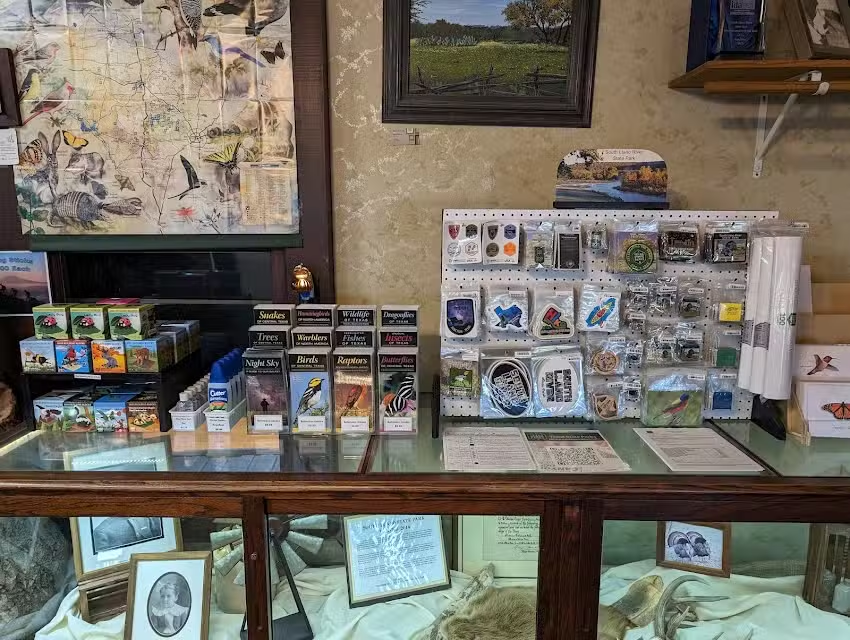
The core function of this facility is to provide comprehensive destination management for South Llano River State Park. Manned by park rangers, who are frequently described as knowledgeable and helpful, the center is the source of all essential information. Here, visitors can pay the daily entrance fees ($5 per adult, children 12 and under are free), check in for reserved campsites, and obtain crucial updates on trail conditions, weather, and any temporary closures. The staff act as on-site travel consultants for the park, offering advice on the best trails for different skill levels, prime fishing spots, and safety protocols. They provide detailed park and trail maps, which are indispensable for navigating the more than 22 miles of trails that range from easy riverfront paths to challenging backcountry routes.
Beyond basic orientation, the center also supports various recreational activities. For instance, they facilitate a loaner program for fishing equipment, allowing visitors to fish within the park without a state license. They also provide information about local services for renting tubes, kayaks, and canoes to enjoy the spring-fed South Llano River. Essentially, the center organizes the logistical side of your adventure travel experience within the park's boundaries.
Positive Aspects for the Prepared Traveler
For those who engage in thorough trip planning, the Visitor Center is an invaluable asset. The primary strength, as highlighted in user feedback, is the helpfulness of the park rangers. Their expertise ensures visitors are well-informed about the park's unique ecosystems and regulations, enhancing both safety and enjoyment. The center is also noted for being wheelchair accessible, a commendable feature that broadens its usability.
The operating hours are fairly consistent, typically running from 8:30 AM to 4:30 PM daily, with extended hours on Fridays during the busier season from Memorial Day to Labor Day. This reliability allows visitors to plan their arrival with confidence. The center is also the hub for information on the park's renowned eco-tourism attractions, such as its status as an International Dark Sky Park, perfect for stargazing, and its role as a major roosting site for the Rio Grande turkey. Staff can provide details on the four bird blinds and offer checklists of the 250+ bird species recorded in the area.
Challenges and Potential Drawbacks
Despite its strengths, there are significant challenges that potential visitors must be aware of, and they largely revolve around a lack of modern conveniences and the necessity of advance preparation. The most critical issue is the park's poor cellular and internet connectivity. One visitor explicitly advises getting an "email download prior to visiting as the network might have issue." This is a substantial drawback in an age where digital maps and online resources are standard travel tools. Visitors must adopt an old-school approach: download all necessary maps, permits, and reservation confirmations before leaving home. Relying on accessing this information upon arrival is a recipe for frustration.
Another major consideration is the park's policy on walk-ins. The official Texas Parks and Wildlife website strongly recommends reservations for both day use and camping, stating that the park often reaches capacity. The sole online review reinforces this, noting that "Walk-ins are rarely allowed depending on the day." This makes spontaneous trips risky. The Visitor Center is not a place where you can simply show up and expect to gain entry, especially during peak seasons (March through October) and weekends. Effective booking services must be utilized through the official state park reservation system well in advance. This reality positions the center less as a welcoming point for casual passersby and more as a check-in counter for pre-approved guests.
Furthermore, the limited number of online reviews makes it difficult to form a broad, long-term picture of the service quality. While the available feedback is positive, a single data point is hardly a comprehensive assessment. Prospective visitors have little user-generated content to draw from when setting their expectations.
Understanding Its True Function
It is best to view the Visitor Center not as a commercial tour operator but as a regulatory and informational gateway. Its purpose is to manage the flow of visitors and provide the resources for a safe and self-directed experience in a natural environment. The center provides the framework for various potential vacation packages focused on outdoor activities—a camping trip, a kayaking weekend, a bird-watching excursion—but the visitor is responsible for executing the plan. The rangers provide the map and the rules; the adventure is up to you.
For example, during the turkey roosting season from October 1st to March 31st, access to the day-use area is restricted to the hours of 10 a.m. to 3 p.m. to protect the birds. This is critical information dispensed at the Visitor Center that profoundly impacts how a day at the park can be structured. Similarly, construction projects, like the utility system upgrades scheduled from late 2025 into 2026, may lead to closures of certain areas like the main camping loop, and the center is the primary source for the most current information on these disruptions.
Conclusion: A Vital Hub Requiring Proactive Planning
In summary, the Visitor Center at South Llano River State Park is an essential and effective facility for its intended purpose: managing a state park. The staff are helpful, the information is vital, and it serves as the nerve center for all park activities. However, its classification as a tourism agency can be misleading. Its strengths are only fully realized by visitors who plan meticulously. You must book in advance, download documents before you arrive, and be prepared for a disconnected experience. For the spontaneous traveler or those expecting the broad services of a commercial travel business, the experience could be disappointing. For the prepared outdoor enthusiast, this Visitor Center is the perfect, no-frills starting point for an immersive natural retreat.