US Forest Service
BackLocated at 420 Barrett Street, the US Forest Service office in Dillon, Montana, functions as a critical resource for visitors, though it diverges significantly from the conventional concept of a travel agency. It doesn't book hotels or arrange commercial tours. Instead, it serves a more foundational purpose: providing the essential information, permits, and expert knowledge required for those looking to engage directly with the vast public lands of Southwest Montana. This office is the administrative hub and public gateway to the Beaverhead-Deerlodge National Forest, the largest national forest in Montana, covering a staggering 3.32 million acres. For the self-reliant traveler focused on outdoor adventures, this office is an indispensable first stop.
The Strengths: An Authoritative Resource for Adventure
The primary asset of the Dillon US Forest Service office is its staff. Visitors consistently report interactions with knowledgeable and helpful personnel. These are not sales agents but rangers and specialists with deep, practical experience in the region. Their advice is not based on brochures but on firsthand knowledge of trail conditions, wildlife activity, and land management realities. This level of expertise is invaluable for effective trip planning, especially in a region where conditions can be unpredictable. They can suggest specific areas for hiking, camping, fishing, or even rockhounding, based on a visitor's interests and experience level.
The office is a comprehensive repository for crucial physical resources. Among the most important are the various maps available for purchase. These include:
- Forest Visitor Maps: These provide a broad overview of the forest, showing main roads, campgrounds, and points of interest.
- Topographic Maps: Essential for serious backcountry navigation, detailing elevation and terrain features.
- Motor Vehicle Use Maps (MVUMs): These are free and legally necessary for anyone planning to use motorized vehicles on forest trails, as they delineate exactly which routes are open to different types of vehicles.
Beyond maps, the office provides a wide array of pamphlets and informational materials. These cover topics from Leave No Trace principles and bear safety to local geology and plant identification. This office is also the designated place to acquire necessary permits that regulate the use of forest resources. This includes permits for cutting Christmas trees, gathering firewood, or collecting minerals and rocks, a service that highlights its unique role in facilitating specific types of Montana travel.
Facilitating Independent Exploration
Unlike a traditional agency that curates a packaged experience, this office empowers visitors to create their own. By providing the tools and information, it supports a more authentic and personal connection with the natural environment. For those planning adventure travel, the ability to speak directly with a ranger about water sources on a multi-day trek or current fire restrictions is far more valuable than any online booking platform. The high user rating of 4.7 stars, aggregated from numerous positive reviews, attests to the value the public places on this direct, authoritative service. Furthermore, the building is noted as having a wheelchair-accessible entrance, ensuring these resources are available to a wider range of visitors.
The Limitations: Managing Visitor Expectations
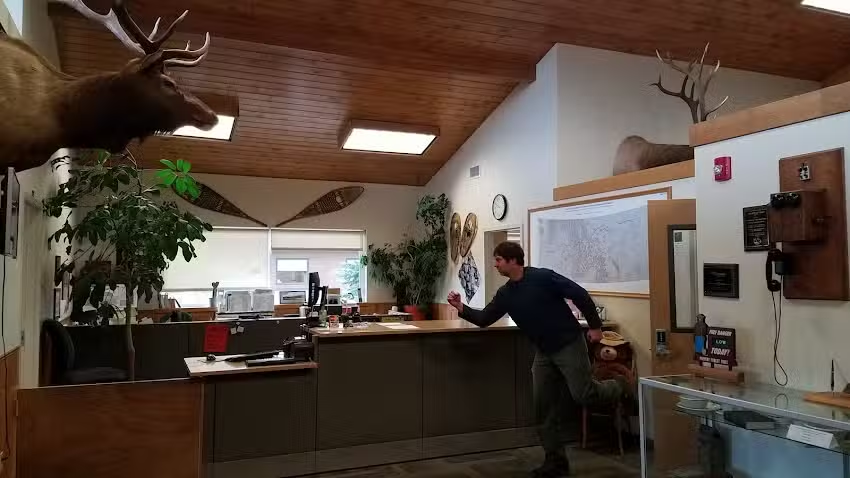
It is crucial for potential visitors to understand what this office is not. It is fundamentally a government administrative and information center, specifically the Supervisor's Office for the Beaverhead-Deerlodge National Forest and the Dillon Ranger District office. One of the most common misconceptions is that it might be a campground or a recreational site itself; it is neither. The building at 420 Barrett Street is a functional workplace, not a tourist destination with exhibits or extensive interpretive displays.
Secondly, this is not a one-stop solution for comprehensive vacation planning. The staff's expertise is deep but highly specialized. They are the authority on the national forest, but they are not equipped to provide information on lodging in Dillon, restaurant recommendations, or details about attractions outside of the lands they manage. Visitors seeking a broader tourism information center for the entire region will need to consult other resources. The scope is strictly limited to the public lands under their jurisdiction.
Finally, the experience is largely self-directed. The staff are there to answer questions and provide materials, but the onus is on the visitor to ask the right questions and synthesize the information. They provide the raw data for a successful trip, but the planning, booking, and execution remain entirely in the hands of the traveler. This approach is ideal for the prepared adventurer but may be daunting for those accustomed to full-service travel arrangements.
Who Should Visit This Office?
The ideal visitor to the Dillon US Forest Service office is an independent traveler, family, or group whose itinerary is centered on the natural landscapes of the Beaverhead-Deerlodge National Forest. This includes:
- Hikers and Backpackers: Seeking detailed trail maps and current conditions for areas like the Anaconda-Pintler or Lee Metcalf wildernesses.
- Campers: Looking for information on the 50 campgrounds within the forest or regulations for dispersed camping.
- Hunters and Anglers: Needing maps of specific hunting districts or access points to rivers and high-mountain lakes.
- Motorized Recreation Users: Requiring the mandatory Motor Vehicle Use Maps for ATVs, dirt bikes, or off-road vehicles.
- Anyone needing a permit: From gathering firewood to collecting crystals at Crystal Park.
In conclusion, while it may be categorized under travel agency, the US Forest Service office in Dillon operates as a specialized travel resource. It offers unparalleled depth of information for a specific type of travel focused on public lands. Its strength lies in its authoritative, expert-driven guidance and essential planning materials. Its limitation is its narrow, non-commercial focus. For travelers whose goal is to immerse themselves in the wild landscapes of Southwest Montana, a visit to this office is not just recommended; it is the most logical and effective starting point for a safe and informed journey.