The Corner Store, Waterford Foundation
BackWhen seeking a travel agency, customers typically envision a service that arranges flights, hotels, and comprehensive vacation packages. The Corner Store, associated with the Waterford Foundation, presents a fundamentally different proposition. It is crucial for potential visitors to understand that this establishment is not a travel agency in the conventional sense. Instead, it functions as a visitor center and retail touchstone for the Waterford National Historic Landmark, offering a highly specialized form of tourism services centered exclusively on the heritage and culture of its immediate surroundings.
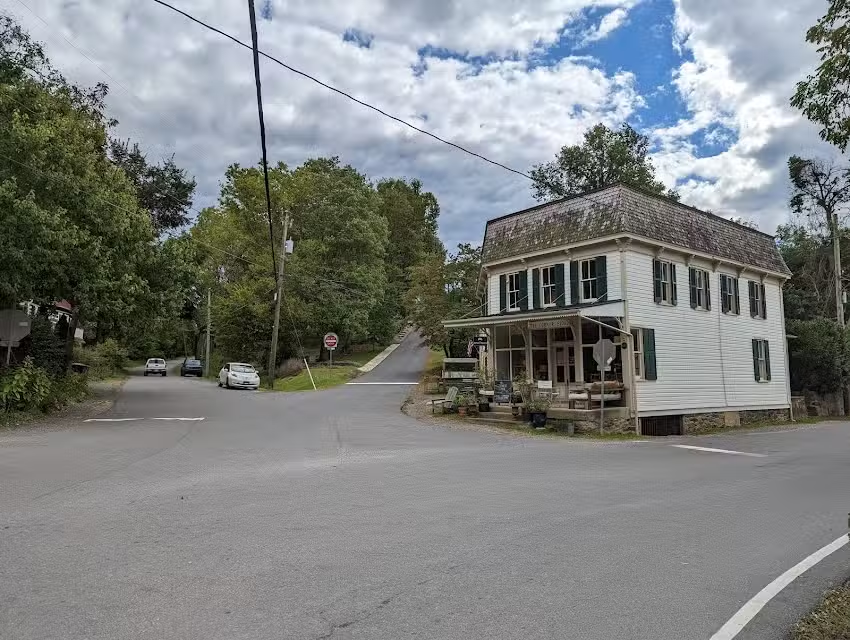
Operated by the Waterford Foundation, an organization founded in 1943 with a mission to preserve the village's historic buildings and character, The Corner Store is deeply integrated into the local preservation effort. This connection is perhaps its greatest strength. Patronage directly supports the foundation's work, which includes maintaining numerous 18th and 19th-century structures and protecting the surrounding landscape from modern development. For travelers who prioritize authentic experiences and wish to contribute to cultural heritage, this model is incredibly appealing. The store itself, housed in a building dating to around 1900, embodies the historical ambiance it seeks to preserve, offering an immersive first impression of the village. This establishment is less about booking a trip and more about enhancing a visit that is already underway, providing a service akin to hyper-local destination management.
What to Expect: Strengths and Unique Offerings
The primary value of The Corner Store lies in its role as a gateway to understanding Waterford. The staff, by nature of their connection to the Foundation, can be expected to possess deep, nuanced knowledge of the village's history, architecture, and points of interest. This expertise serves as a form of specialized travel consultation, invaluable for anyone wishing to appreciate the context behind the well-preserved buildings. Instead of brochures for international resorts, visitors will find locally-sourced goods, artisan crafts, books on regional history, and perhaps even food and wine from the area. This focus on local and handmade products aligns with its mission and offers a unique shopping experience that is directly tied to the destination itself.
The store effectively serves as the starting point for a self-guided tour of a living community where the majority of homes were built before 1861. The Waterford Foundation has been instrumental in ensuring the village and its 1,420 acres of surrounding farmland remain unspoiled, an achievement that led to its designation as a National Historic Landmark in 1970. This makes a visit to The Corner Store more than just a stop; it is an entry into a meticulously preserved piece of American history.
Significant Limitations and Considerations
Despite its unique strengths, The Corner Store has considerable drawbacks that potential visitors must factor into their travel planning. The most significant is its extremely limited operating hours. Being closed from Monday through Thursday severely restricts access for many travelers, particularly those on extended trips or spontaneous visits during the week. This schedule necessitates careful planning and positions the store, and by extension the village's welcome services, as a weekend-only destination for the most part. This can be a major inconvenience and a point of frustration for those unaware of the restricted schedule.
Another major challenge is the scarcity of public feedback and online reviews. With only a single textless review noted in some records, prospective visitors have very little user-generated information to set their expectations. In an era where travelers rely heavily on the shared experiences of others to make decisions, this lack of an established online reputation is a distinct disadvantage. It creates uncertainty about the quality of the experience and the specific offerings available at any given time.
Furthermore, the classification of the business as a 'travel agency' is misleading. Anyone searching for traditional tour operators or services to arrange multi-day itineraries, transportation, or lodging will be disappointed. The store's scope is strictly confined to Waterford. While it excels in its niche, it does not provide the broader tourism services that the category label implies. This mismatch in labeling can lead to confusion and wasted time for customers with different needs.
Who Is This For?
The Corner Store is ideally suited for a specific type of visitor:
- History Enthusiasts: Individuals with a keen interest in early American history, architecture, and rural life will find the store and its parent foundation to be an invaluable resource.
- Cultural Tourists: Travelers seeking authentic experiences and a direct connection to the places they visit will appreciate the store's mission-driven approach and its focus on local craftsmanship.
- Supporters of Historic Preservation: For those who believe in preserving cultural heritage, shopping at The Corner Store is a way to directly contribute to the cause.
Conversely, this establishment is not suitable for:
- General Tourists Needing Broad Services: Anyone looking to book flights, hotels, or complex custom itineraries will need to seek out a conventional travel agency.
- Spontaneous Weekday Visitors: The limited hours mean that those passing through the area between Monday and Thursday will likely find it closed.
- Travelers Reliant on Peer Reviews: Individuals who depend on a wealth of online reviews to vet their destinations will find a notable lack of information.
Conclusion
In summary, The Corner Store by the Waterford Foundation is not a business that fits neatly into a standard category. It is a specialized retail and information hub dedicated to the preservation and interpretation of a unique historical landmark. Its strengths are its authenticity, deep local expertise, and the direct support it provides to the Waterford Foundation's preservation mission. However, these are offset by significant weaknesses, including highly restrictive operating hours and a near-total absence of an online review footprint. For the right visitor, it is an essential and enriching part of the Waterford experience; for others, it may be an inconvenient or irrelevant stop. Clear-eyed awareness of what it offers—and what it does not—is essential for any potential visitor.