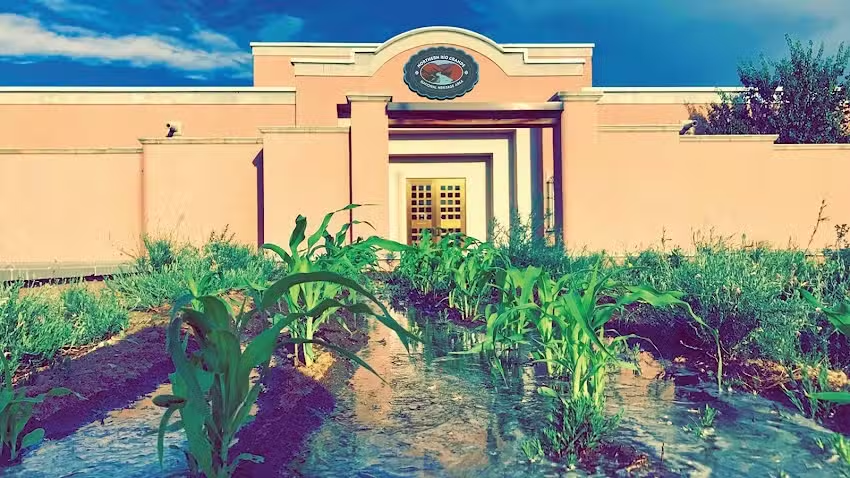
Northern Rio Grande National Heritage Center
BackThe Northern Rio Grande National Heritage Center is positioned not merely as a business but as a crucial cultural custodian for Northern New Mexico. Functioning as a multi-faceted institution that is part tourist attraction, part museum, and part community hub, it provides a deep dive into the intertwined histories of the region's Pueblo, Hispanic, and Anglo cultures. For travelers looking to move beyond superficial sightseeing, this center in Española serves as an essential starting point for any meaningful itinerary planning in the area, which includes the counties of Rio Arriba, Santa Fe, and Taos. It operates with a clear mission: to sustain and preserve the unique languages, traditions, and environments of this historically rich landscape through partnerships, education, and interpretation.
The Visitor Experience: Strengths and Offerings
The primary strength of the Northern Rio Grande National Heritage Center lies in its role as an authentic gateway to the region's soul. Unlike a conventional travel agency that might focus on logistics and bookings, this center excels in providing context and educational depth. It is a resource for those interested in cultural tourism, helping visitors understand the significance of the sites they plan to see, from the ancient Pueblo dwellings to Spanish colonial architecture. The organization is federally designated and was established by the US Congress in 2006 to help conserve the area's vast resources. This official standing underlines its credibility and importance.
One of its key functions is promoting heritage tours and facilitating economic development through tourism. The center is involved in a wide array of community projects, from supporting local artists and language preservation programs to developing film and media initiatives in the region. This deep community integration means that the information and experiences it offers are grounded in local reality. Visitors benefit from this by gaining access to a more genuine perspective than what is typically available through standard tourism channels. The facility itself is also noted for being accessible, with a wheelchair-accessible entrance, ensuring that a wider range of visitors can access its offerings.
Services and Resources for Travelers
While it may not offer all-inclusive vacation packages, the center acts as a de facto planner for bespoke journeys. Its staff and exhibits can provide invaluable information for creating custom trips focused on specific interests, whether that's art, history, archaeology, or nature. The center serves as a hub for information on numerous significant sites within the heritage area, including:
- Eight different Native American Pueblos, including the Taos Pueblo, a UNESCO World Heritage Site.
- National Parks and Monuments like Bandelier National Monument and Valles Caldera National Preserve.
- Scenic byways such as the High Road to Taos and El Camino Real National Scenic Byway.
- Historic Spanish colonial sites and dozens of properties on the National Register of Historic Places.
Furthermore, the organization hosts and promotes events like the Cultures and Creators Visual Arts Festival and the Rio Grande Sky Fiesta, which offer immersive cultural experiences. For travelers, these events represent a unique opportunity to engage directly with the local community and its traditions. Although the online reviews are sparse, the existing ones are exceptionally positive, with one visitor describing it as an "excellent venue with interesting history," contributing to a perfect 5-star rating. This suggests that those who do visit have a highly satisfactory experience.
Considerations for Potential Visitors
Despite its significant cultural value, there are practical limitations that potential visitors should consider. The most notable is the operating schedule. The center is open from 10:00 AM to 4:00 PM, Tuesday through Saturday, but is closed on Sundays and Mondays. This schedule can be a significant drawback for weekend travelers or those on a short trip who might rely on a Sunday visit to plan the rest of their week. Careful advance planning is necessary to align a visit with their open hours.
Another point of consideration is the scope of its services. The designation as a "travel agency" in its business profile could be misinterpreted. Visitors seeking a one-stop-shop for booking flights, hotels, and rental cars will not find those services here. The center's role is that of an expert consultant and informational resource, not a transactional booking agent. Its focus is on enriching a traveler's understanding and helping them discover the local attractions, rather than managing the logistical aspects of a trip. This distinction is crucial for managing expectations.
Finally, the limited number of online reviews, while positive, makes it difficult to gather a broad consensus on the visitor experience. With only a handful of ratings, prospective visitors have less user-generated feedback to rely on compared to more widely reviewed attractions. This lack of a substantial digital footprint means that travelers must place more trust in the institution's official mission and the information it provides directly.
Conclusion: An Essential Stop for the Curious Traveler
In summary, the Northern Rio Grande National Heritage Center is not a typical tourism business but a vital cultural institution that offers immense value to a specific type of traveler. It is an indispensable resource for anyone dedicated to engaging with Northern New Mexico on a deeper level. As a premier hub for cultural tourism, it provides the historical and cultural framework necessary to truly appreciate the region's complex heritage. While its limited hours and the niche nature of its services require forethought, the depth of knowledge and authentic connection it offers make it an essential first stop. For those whose goal is to understand the story of the land and its people, a visit to this center is a critical step in planning an enriching and memorable journey.