New Hope Center (Y-12 History Center)
BackThe New Hope Center, which houses the Y-12 History Center, offers a very specific and concentrated look into one of the most secretive and significant sites of the 20th century: the Y-12 National Security Complex in Oak Ridge, Tennessee. This facility is not a sprawling museum but rather a compact interpretive center designed for a focused visit. For those undertaking historical tours centered on the Manhattan Project, it serves as an essential, albeit brief, point of interest. Its high average rating of 4.6 stars from nearly 200 visitors indicates a high level of satisfaction, but potential visitors must align their expectations with the reality of what the center offers, including its considerable logistical limitations.
The Visitor Experience: A Focused Historical Dive
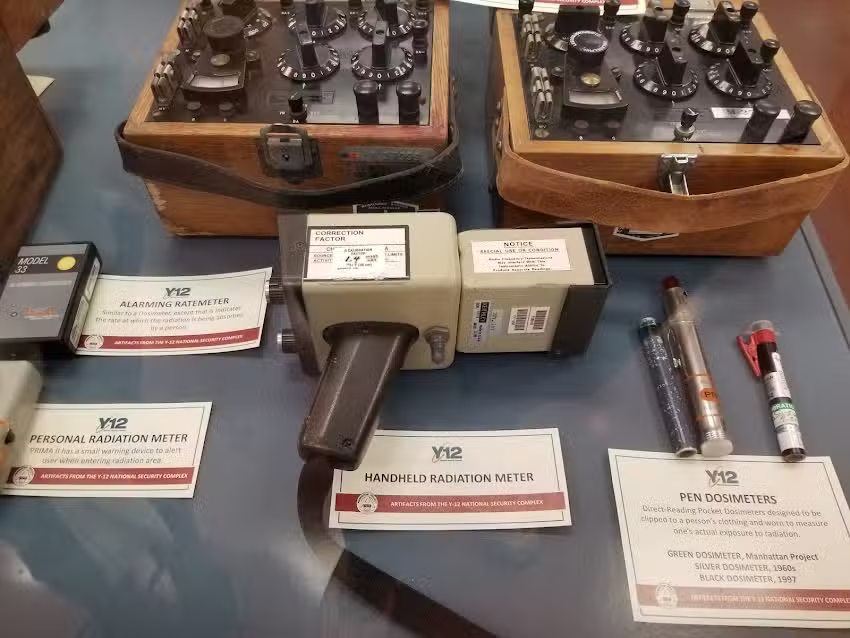
Upon entering the New Hope Center—a process that involves being buzzed in through a secure lobby and potentially presenting identification—visitors are met with a well-curated collection of exhibits. The primary focus is on Y-12's crucial role in the Manhattan Project, specifically the electromagnetic separation process used to enrich uranium for the "Little Boy" atomic bomb. The displays are lauded by many for being highly informative, featuring a compelling mix of informational panels and historical artifacts that chronicle the site's rapid development and its early, world-altering missions. The content provides a dense, educational experience that is a cornerstone of American heritage tourism.
Visitors have praised the quality of the information presented, noting that the staff and tour guides are both friendly and exceptionally knowledgeable. They provide context that brings the static displays to life, offering insights into both the historical operations and the complex's ongoing national security efforts. This personal touch elevates the experience beyond a simple walkthrough. One of the more unique and frequently mentioned artifacts is a sample of moon dust, a fascinating and unexpected find that speaks to the diverse scientific contributions of the broader Oak Ridge complex over the decades. For adults with a genuine interest in science, history, or military technology, the center is a rewarding stop.
Strengths of the New Hope Center:
- Rich, Specific Content: The center excels at telling the specific story of the Y-12 complex, a narrative not as broadly covered at other regional museums. It's a prime destination for educational travel.
- Knowledgeable Staff: The presence of informed guides who can answer detailed questions is a significant asset, making the visit more interactive and meaningful.
- Authentic Location: Being situated at the entrance to the actual Y-12 complex adds a layer of authenticity and gravity to the experience that cannot be replicated elsewhere. It is one of the key tourist attractions within the Manhattan Project National Historical Park.
Managing Expectations: The Center's Limitations
While the content is excellent, the most consistent piece of feedback from visitors is the center's small size. It is not a destination that requires a full day, or even half a day, of travel planning. Most people report that a visit lasting between 30 and 60 minutes is sufficient to see everything. This is a critical point for travelers to understand. Many reviews explicitly compare it to the K-25 History Center, another component of the Manhattan Project history in Oak Ridge, noting that K-25 is significantly larger, more comprehensive, and more interactive. Consequently, several visitors suggest that if time is limited, K-25 should be the priority. The New Hope Center is best viewed as a valuable supplement to a larger sightseeing tour of the area's historical sites, rather than its main attraction.
Another significant drawback is the center's appeal—or lack thereof—to younger audiences. The exhibits are text-heavy and technical, focusing on historical and scientific details that are unlikely to engage children. Families planning a trip to the region should be aware that this particular stop may not be suitable for all members. This is an important consideration for those looking for family-friendly US history destinations.
Points of Caution for Visitors:
- Extremely Limited Hours: This is perhaps the center's biggest challenge for tourists. It is only open from Monday to Thursday, typically from 6:00 AM to 4:00 PM, and is closed entirely on Fridays, Saturdays, and Sundays. This schedule makes it inaccessible for weekend travelers and requires careful weekday planning.
- Small Physical Size: Do not expect a large museum. The exhibits are contained within a relatively small portion of the New Hope Center's lobby and an adjacent area.
- Not for Children: The dense, academic nature of the displays makes it a poor choice for most visitors under the high school level.
- Security and Access: The center is the public face of a high-security government facility. Visitors should be prepared for a formal entry process and be mindful of restrictions on photography in the surrounding areas. Follow all posted signs and instructions from security personnel.
Planning Your Visit: A Practical Approach
While it is not a traditional travel agency, the New Hope Center serves as a gateway for a specific type of historical journey. To make the most of a visit, proper planning is essential. First and foremost, verify the operating hours on the official National Park Service website before you go, as they can change. Given the limited schedule, it's best to incorporate this stop into a weekday itinerary that also includes the American Museum of Science and Energy and the K-25 History Center.
Finding the center requires careful navigation. As one visitor helpfully pointed out, GPS directions will lead you to the correct building, but you must be careful not to turn into the main, guarded entrance for the Y-12 complex. The public entrance for the New Hope Center is located by continuing straight, staying to the left, and following signs specifically for the visitor center. This small detail can prevent a confusing and potentially problematic detour. A recommended strategy is to begin your day at the main Manhattan Project National Historical Park visitor center (located within the Children's Museum of Oak Ridge) to get an orientation from a park ranger who can provide maps and context for all the local historical sites, including Y-12.
In conclusion, the New Hope Center (Y-12 History Center) is a high-quality, specialized institution. It offers a rare and valuable public window into the history and ongoing mission of the Y-12 National Security Complex. For history buffs, academics, and those deeply invested in the story of the Manhattan Project, it is an indispensable stop. However, its very specific focus, small scale, and highly restrictive hours mean it is not for every tourist. A successful visit depends on understanding its role as a concentrated, supplementary piece of a larger historical puzzle in Oak Ridge.