
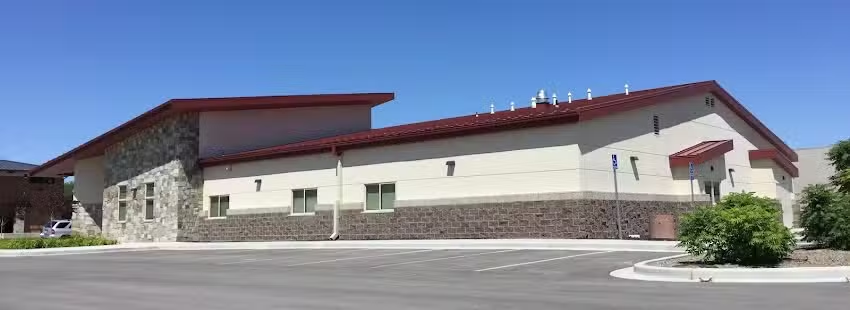
Millard County Visitor’s Center – Delta
BackThe Millard County Visitor's Center in Delta serves as an official outpost for tourist information in a region of Utah known for its vast, rugged landscapes and unique historical sites. As a government-supported entity, it is positioned to be a primary resource for travelers. However, its practical usefulness is a subject of significant debate, primarily revolving around its operational capacity versus the actual needs of tourists. This creates a complex picture for anyone relying on it for trip planning.
Functioning as the area's official tourist information center, its greatest strength lies in the potential for providing authoritative and curated information. Visitors can typically expect to find official maps, brochures, and pamphlets detailing the county's main attractions. Millard County is a destination for specific types of adventure travel, including rockhounding at Topaz Mountain, exploring lava tubes, and off-roading on extensive ATV trails. The center should be the ideal starting point for these local excursions, offering guidance on locations, safety, and necessary permits. Furthermore, the county holds significant historical weight, most notably the Topaz Museum, which chronicles the internment of Japanese Americans during WWII. An effective visitor center would provide context and directions to this and other sites like the Great Basin Museum and historic Cove Fort. The facility is also noted as having a wheelchair-accessible entrance, an important feature for ensuring all travelers can access its services.
A Critical Look at Accessibility and Operations
Despite its potential, the Millard County Visitor's Center is severely constrained by its operating hours. The facility is closed every Wednesday, Saturday, and Sunday. On the days it is open, the hours are limited: 9:00 AM to 3:00 PM on Mondays, Tuesdays, and Thursdays, with an even shorter window of 9:00 AM to 1:00 PM on Fridays. This schedule presents a major obstacle for the very people it aims to serve. Tourists, particularly those on a road trip, frequently travel on weekends. Arriving in Delta on a Saturday with plans to explore the area, only to find the primary information hub closed, can be a significant setback.
This exact issue is reflected in the sparse online feedback available for the center. The most prominent Google review gives it a one-star rating with the simple, direct complaint: "closed on saturday." This single data point speaks volumes, encapsulating the frustration of a visitor whose needs did not align with the center's schedule. For a service-oriented establishment in the tourism sector, being unavailable during peak leisure time is a fundamental operational flaw. Potential visitors planning to use this center as a resource must structure their arrival in Delta to fit within a very narrow weekday window, which is often impractical.
Resources vs. Reality for the Modern Traveler
For travelers undertaking serious itinerary planning, a visitor center can be an invaluable asset. The staff, presumably locals, can offer nuanced advice that isn't easily found online—such as current road conditions, lesser-known points of interest, or recommendations for local services. This kind of travel consultation is what separates a physical center from a website. However, the restrictive hours largely negate this benefit. A traveler cannot spontaneously adjust their plans and seek advice if the center is closed more often than it is open during daylight hours.
The official Millard County tourism website, while a useful digital alternative, cannot fully replace the in-person experience. Having a physical map in hand is crucial in a region where cell service can be unreliable. Discussing a potential route with someone knowledgeable can prevent wasted time or unsafe travel choices. The center's failure to provide consistent access means that travelers are often left to rely solely on digital tools, which may not be sufficient for navigating the remote parts of the Great Basin. This operational model positions the center less as a dynamic travel agency and more as a passive archive of information, accessible only to a few.
Strategic Alternatives and Recommendations
Given the challenges, prospective visitors to Millard County should adjust their expectations and strategies. It is highly advisable to treat the visitor center as a secondary or bonus resource rather than a primary one. Here are some key considerations:
- Plan Ahead Online: Before your trip, thoroughly review the Millard County tourism website. It lists numerous attractions, from the Pahvant Heritage Trail to Crystal Ball Cave, providing a solid foundation for your plans.
- Call Ahead: If your schedule does allow for a weekday visit, call the visitor center at (435) 864-4316 beforehand. Confirm their hours and inquire if they have the specific information you need (e.g., maps for certain ATV trails or guides for rockhounding).
- Visit Other Local Institutions: The Topaz Museum, also located in Delta, has more consistent hours (Monday-Saturday, 10:00 AM - 5:00 PM) and its staff may be able to provide some local information. While its focus is specific, it serves as another point of contact for visitors in the town.
- Be Self-Sufficient: For any trip into the West Desert, self-sufficiency is key. Download offline maps, ensure your vehicle is in good condition, and carry extra water, food, and emergency supplies. Do not rely on being able to acquire critical information upon arrival, especially on a weekend.
In conclusion, the Millard County Visitor's Center in Delta is an establishment with a valuable mission but a deeply flawed execution. It holds the promise of being a gateway to the region's many attractions, from its geologic wonders to its poignant history. The wheelchair accessibility is a commendable feature. However, its extremely limited operating hours, particularly its weekend closures, render it unreliable for a majority of travelers. It stands as a paradox: a tourist information center that is largely inaccessible to tourists. While it can be a helpful stop for the rare visitor who arrives during its brief open hours, most will need to conduct their trip planning independently and view a successful visit to the center as a matter of luck rather than a dependable part of their journey.