Great Falls Discovery Center
BackLocated in a complex of refurbished historic mill buildings in Turners Falls, the Great Falls Discovery Center presents a unique proposition for travelers. Operated by the Massachusetts Department of Conservation and Recreation (DCR), it functions less like a commercial business and more as a public service institution. While it is categorized under various labels including museum, park, and even travel agency, its primary role is that of a visitor center and educational hub for the Connecticut River watershed. Its high user rating of 4.7 stars from over 300 reviews suggests a consistently positive public reception, but prospective visitors should understand its specific offerings to align their expectations.
A Hub for Learning and Local Insight
The core of the Great Falls Discovery Center is its museum component, which is consistently praised for its quality and educational value. The main exhibits feature a series of intricate, life-size dioramas that depict the flora and fauna of the Connecticut River watershed, tracing it from its source near Canada down to the Long Island Sound. Visitors have lauded the incredible realism of these displays, particularly noting the beautifully painted backgrounds by local artists that create an immersive, three-dimensional effect. These exhibits offer a comprehensive look at the area's natural, cultural, and industrial history, making the center a valuable resource for those undertaking educational travel or simply wishing to understand the region on a deeper level. The friendly and knowledgeable DCR staff, often described as rangers, are frequently on hand to answer questions and provide deeper context, adding a personal touch that enhances the experience.
One of the most significant advantages of the center is its cost: admission is entirely free. This makes it an exceptional destination for any budget traveler, families, and school groups. The facility is also noted for being fully wheelchair accessible, ensuring that its offerings are available to a wide audience. Beyond the main exhibit hall, the center utilizes its space for dynamic community purposes. The Great Hall, a former machine shop with high ceilings and brick walls, serves as a venue for rotating art exhibits, concerts, and community events, such as the monthly Coffeehouses hosted by the Friends of the Great Falls Discovery Center. This multi-use approach means the center is not just a static museum but a lively hub of cultural tourism.
More Than a Museum: A Gateway to Outdoor Activity
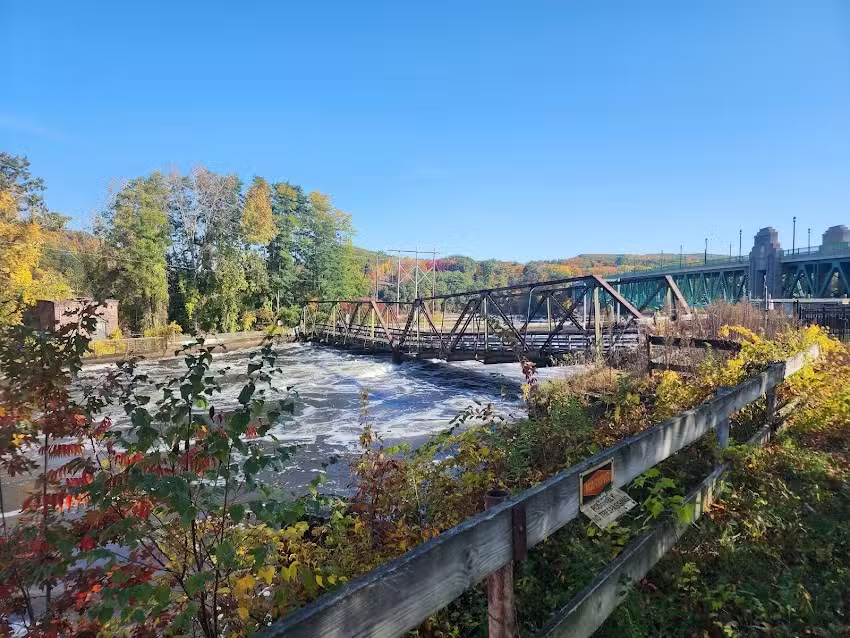
The center's strategic location is one of its strongest assets. Situated on four acres of gardens and lawns next to the Connecticut River, it provides a serene environment for picnics and relaxation. More importantly, it serves as a direct access point to the Canalside Rail Trail. This 3.7-mile trail is ideal for walking and biking, offering scenic views along the river and the historic power canal. The center effectively functions as a starting point for various forms of outdoor activities and adventure travel. Visitors can easily spend part of their day exploring the museum's exhibits before embarking on a bike ride or a long walk. The staff can provide information and maps for self-guided tours of the area, including a historic walking tour of Turners Falls and a geologic tour. This informational role is how the center fulfills its function as a type of destination management company for the immediate area, providing the resources for visitors to create their own experiences rather than booking pre-packaged ones.
Clarifying the "Travel Agency" Role
It is crucial for potential visitors to understand that the "travel agency" classification is non-traditional. The Great Falls Discovery Center does not book flights and hotels or arrange complex all-inclusive packages like a commercial tour operator. Its services in this domain are purely informational. It is a visitor center in the truest sense, equipping travelers with knowledge about local history, ecology, and recreational opportunities. For the independent traveler looking to build their own itinerary, this is an invaluable, non-commercial resource. However, anyone seeking transactional booking services will need to look elsewhere. This distinction is key to preventing disappointment.
Potential Drawbacks and Considerations for Travel Planning
While overwhelmingly positive, feedback and operational details highlight a few potential downsides that require careful travel planning. The most commonly cited issue is the center's small size. Many reviewers note that it is perfect for a "quick stop," but it is not a large institution that can occupy an entire day. Visitors expecting an expansive, multi-building museum complex might find the experience shorter than anticipated. An AI-generated summary of reviews pointed out that some visitors wished for more extensive exhibits. Therefore, it's best viewed as a high-quality, focused experience of one to two hours, which can be combined with other local activities.
Another point of consideration is the operating hours. The center is closed on Mondays (except for Monday holidays) and has variable closing times on other days—4:00 PM on Tuesdays but 6:00 PM from Wednesday to Sunday. Visitors must verify the hours on the official website before planning their trip to avoid arriving at a closed facility.
Finally, while the core dioramas are a permanent fixture, the freshness of the experience for repeat visitors may depend on the rotating exhibits in the Great Hall or the schedule of public events. Those who have seen the main exhibits may find less to draw them back unless they are attending a specific program, such as the Archaeology Month events or a new art installation. This is not a major flaw but a characteristic of a smaller, community-focused institution.
Final Assessment
The Great Falls Discovery Center is a valuable and highly-regarded asset for both the local community and visitors to Turners Falls. It excels as a free, accessible, and educational museum that provides a superb introduction to the natural history of the Connecticut River. Its role as a gateway to the Canalside Rail Trail and other local sightseeing tours makes it an excellent starting point for a day of exploration. While its small scale and non-traditional function as a "travel agency" must be understood to set proper expectations, its friendly staff, beautiful setting, and commitment to community engagement make it a highly recommended stop for a wide range of travelers, from families on a budget to enthusiasts of eco-tourism.