
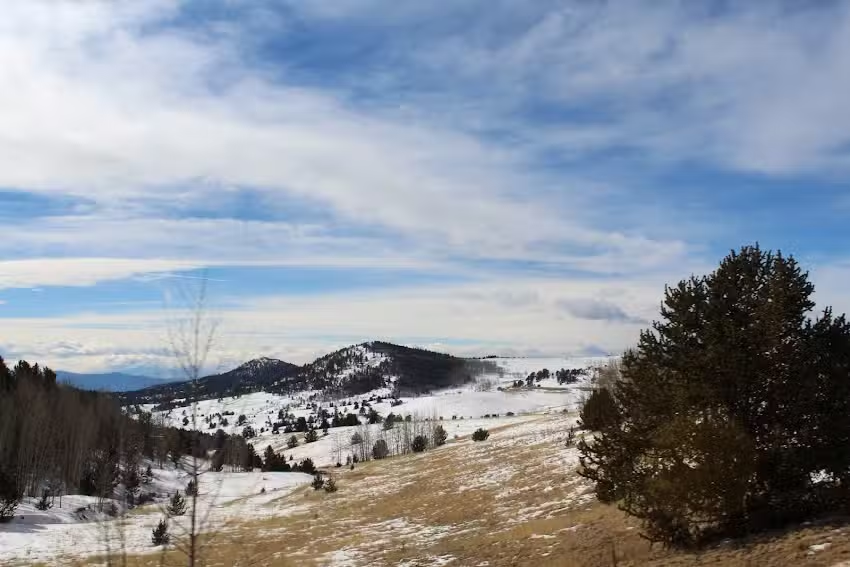
Gold Belt Tour Scenic
BackWhen considering the Gold Belt Tour Scenic and Historic Byway, it is essential to first understand what it is—and perhaps more importantly, what it is not. The listing of this entity as a travel agency can be misleading. This is not a business that books vacation packages or provides scheduled transportation. Instead, it is a nationally recognized scenic byway, a collection of public roads managed by an association, inviting travelers to create their own self-guided tours through a rugged and historically significant part of Colorado. The experience is raw, largely uncurated by commercial ventures, and places the responsibility of road trip planning squarely on the visitor. This distinction is the root of the highly polarized opinions it receives, ranging from five-star "bucket list" experiences to one-star ratings from those likely caught unprepared.
The Essence of the Experience
The Gold Belt Tour is a 131-mile network of roads that follow the 19th-century stagecoach and railroad routes connecting the gold mining camps of Cripple Creek and Victor to the Arkansas River Valley towns of Cañon City and Florence. The byway is not a single road but a loop with several distinct legs, each offering a different character. The primary routes include Phantom Canyon Road, Shelf Road, High Park Road, and Teller County Road 1. This journey is a deep dive into cultural heritage tourism, taking visitors past abandoned mine shafts, decaying headframes, and historic towns that were once the epicenter of one of the world's largest gold rushes. Beyond the human history, the route traverses significant paleontological sites, including the Florissant Fossil Beds National Monument and the Garden Park Dinosaur Fossil Area, adding a layer of natural history that predates the gold boom by millions of years.
The Routes: A Study in Contrasts
High Park Road & Teller County Road 1
For those seeking a more conventional scenic drive, parts of the byway are accommodating. High Park Road, for instance, is paved and offers expansive views of rolling ranchlands and distant mountain ranges like the Sangre de Cristo. It was one of the primary connections for ranches and farms to the valley below. Similarly, Teller County Road 1, the original stagecoach path to Cripple Creek, is a relatively gentle introduction to the area's history and landscape, conveniently located near the accessible Florissant Fossil Beds.
Phantom Canyon Road & Shelf Road
The core of the byway's reputation for adventure travel lies in two specific sections: Phantom Canyon Road and Shelf Road. Phantom Canyon Road follows the original Florence & Cripple Creek Railroad grade. It's an unpaved route that winds through a narrow canyon, crossing single-lane wooden bridges and passing through two stone tunnels carved for the long-gone train. The road is restricted for vehicles over 25 feet long, a clear indicator of its tight confines. Shelf Road is even more formidable. As its name implies, a significant portion of this road is a narrow shelf cut into a canyon wall, at times perched hundreds of feet above Fourmile Creek with no guardrails. It was the first direct route from Cañon City to the mining district and remains a thrilling, and for some, terrifying, drive. These roads define the Gold Belt Tour and are the primary reason why a visitor's experience can be either exhilarating or deeply unsettling.
The Positive Attributes: Why People Seek It Out
For the right kind of traveler, the Gold Belt Tour is an exceptional opportunity. The lack of commercialism is a major draw. This isn't a polished theme park version of the Old West; it is the real thing, with all its grit and decay. This authenticity is a powerful magnet for history enthusiasts, photographers, and those seeking an escape from crowded tourist destinations. The byway offers a framework for creating unique travel itineraries focused on geology, paleontology, or industrial history. The managing association's website provides maps and information, but the journey itself is one of personal discovery.
The scenic value is undeniable. From the high-altitude parklands to the dramatic depths of the canyons, the landscape is varied and often breathtaking. The drive offers a tangible connection to the past, as navigating the tight curves of Phantom Canyon in a modern vehicle evokes an appreciation for the engineering and labor required to build a railroad there in the 1890s. For those with capable vehicles, the drive itself is the main attraction, a challenging and engaging experience that stands in stark contrast to monotonous interstate travel. It is a prime example of rewarding ecotourism, where the primary activity is observing and appreciating a region's natural state and historical footprint with minimal modern intrusion.
Points of Caution: The Unvarnished Reality
The very qualities that make the Gold Belt Tour appealing to some are significant drawbacks for others. The low overall rating on some platforms, influenced by starkly negative reviews, stems almost entirely from a mismatch of expectations and reality. The most critical point of failure is vehicle preparedness. Attempting to drive Shelf Road or Phantom Canyon in a low-clearance sedan, a large RV, or any vehicle in poor condition is ill-advised and potentially dangerous. Four-wheel drive is often recommended, especially for Shelf Road or in inclement weather.
Furthermore, the infrastructure is minimal. Services like gas, food, and restrooms are clustered in the towns at either end of the byway, such as Cripple Creek and Cañon City, but are virtually nonexistent along the unpaved sections. A trip here requires careful planning, including a full tank of gas, water, and food. Cell service is unreliable at best. The roads can be intimidating for anyone uncomfortable with heights, narrow passages, or driving on gravel surfaces without guardrails. This is not a relaxing Sunday drive for a nervous driver. The experience can quickly turn from adventurous to frightening if one is not mentally and mechanically prepared for the conditions.
Conclusion: An Informed Decision is Key
Ultimately, the Gold Belt Tour Scenic and Historic Byway is neither inherently good nor bad; it is a specialized experience that caters to a specific audience. It is not a conventional tourist attraction and should not be approached as one. It is a piece of living history presented as-is, a challenging drive through a landscape that has not been sanitized for mass consumption. It offers no organized historical tours from a central tour operator, but rather provides the setting for a personal expedition.
Potential visitors must honestly assess their comfort level with rugged conditions and their vehicle's capabilities. If the idea of a narrow, unpaved mountain road with steep drop-offs is exciting, this byway will likely be a highlight of any trip to Colorado. If that same description causes anxiety, it is best to stick to the paved portions like High Park Road or choose another destination entirely. The Gold Belt Tour's value is in its authenticity, but that authenticity comes with demands. For the prepared adventurer, it is a deeply rewarding journey into the heart of Colorado's wild and storied past. For the unprepared, it can be a cautionary tale in the importance of research before embarking on a journey.