
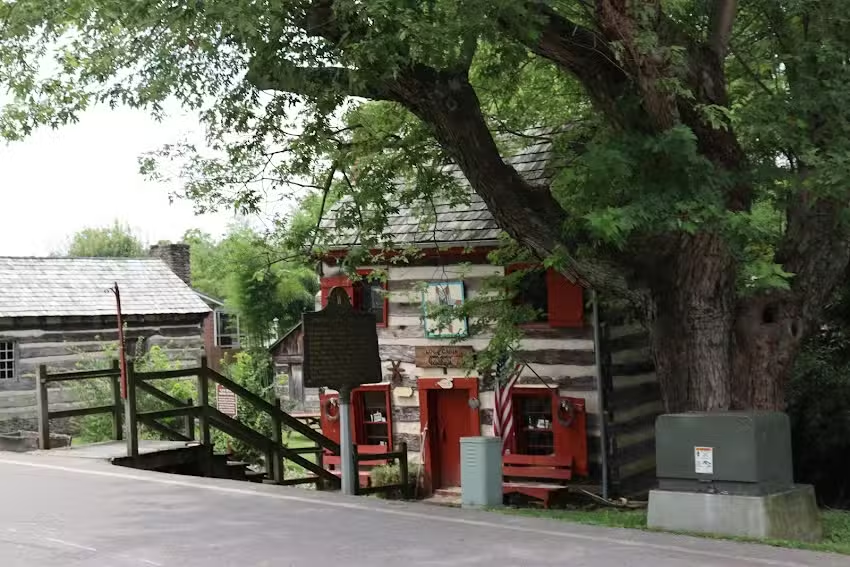
“Cane Brake” Visitor’s Center
BackThe "Cane Brake" Visitor's Center serves as the primary gateway for individuals and groups engaging in tourism within the historic Old Washington district of Maysville, Kentucky. Functioning as the operational hub for the area's main attractions, this establishment is not merely a point of interest but a necessary first stop for anyone wishing to experience the historical offerings of the neighborhood. Its role is more akin to a highly specialized travel agency, focused exclusively on the tightly knit collection of historic sites within its immediate vicinity. The center's physical location is one of its strongest assets, placing visitors directly at the starting point of their historical journey, eliminating the confusion that can often accompany self-directed tours in unfamiliar locales.
A Foundational Element of the On-Site Visitor Experience
The most significant advantage offered by the "Cane Brake" Visitor's Center is its function as a centralized service provider. This is the exclusive location where visitors can purchase tour tickets for the historic house museums that define the area, including the Albert Sidney Johnston House and the Harriet Beecher Stowe Slavery to Freedom Museum. This model ensures that visitors have a single, clear point of contact. By controlling ticketing, the center effectively manages visitor flow and provides a structured beginning to the local experience. This approach is beneficial for travelers who may feel overwhelmed by multiple ticketing points and varied schedules, streamlining the process of accessing the key local attractions. For those arriving with a loose schedule, the center provides the necessary structure to build a day's worth of activities.
Furthermore, the building itself contributes positively to the visitor experience. The architecture, reminiscent of a rustic log structure, is thematically consistent with the historic nature of Old Washington. This thoughtful presentation means that the process of gathering information and purchasing tickets does not feel like a sterile transaction but rather the first step into the historical narrative of the area. The physical environment is designed to prime visitors for the experience ahead. Another crucial positive aspect is the facility's commitment to accessibility, as it features a wheelchair-accessible entrance. In a district filled with historic buildings that may present physical barriers, this modern amenity ensures that a wider range of visitors can begin their journey comfortably and with dignity.
The Role as an Information Repository
As the official welcome center, it is positioned to be the most reliable source of travel information for the district. Visitors can procure maps, brochures, and, most importantly, receive verbal context and recommendations from staff. While online reviews about staff helpfulness are nonexistent, the center's official designation implies that the personnel are equipped with specialized knowledge of the area's history and logistics. This human element is invaluable for visitors looking to create custom itineraries based on their interests or time constraints. Staff can provide details on tour lengths, walking distances between sites, and other practical advice that is often difficult to find online, making the on-the-ground vacation planning process much smoother.
Significant Shortcomings in the Digital Realm
Despite its strengths as a physical facility, the "Cane Brake" Visitor's Center has a profoundly weak digital presence, which stands as its most significant drawback for the modern traveler. The official website associated with the center is severely outdated, employing a design and user interface that feels decades old. For potential visitors conducting preliminary research, this can be a major red flag. A poorly maintained website can create an impression of a neglected or unprofessional operation, potentially deterring travelers who are accustomed to sleek, informative, and easy-to-navigate digital resources from contemporary tour operators.
This digital deficiency extends to a near-total lack of an online feedback loop. The business has accumulated virtually no user reviews across major travel platforms. In an era where social proof is a primary driver of consumer decisions, this absence is conspicuous. Prospective visitors have no peer reviews to consult to gauge the quality of the tours, the value of the ticket price, or the helpfulness of the staff. This forces travelers to take a leap of faith, which many are unwilling to do when planning their valuable leisure time. Effective destination management in the 21st century requires active engagement with online communities, and in this regard, the center is falling far short.
Impediments to Modern Travel Planning
Perhaps the most critical failure of its digital strategy is the complete absence of online booking capabilities. Visitors cannot purchase tickets in advance; they must do so in person upon arrival. This operational model is inconvenient and out of step with current industry standards. It prevents travelers from securing their plans ahead of time and can lead to uncertainty regarding availability, especially during peak seasons. For those planning a comprehensive trip package involving multiple destinations, the inability to pre-book this component adds a layer of logistical friction. It creates a disadvantage when compared to other attractions that offer the convenience of securing tickets with a few clicks.
The lack of a robust online presence also means that detailed information for pre-trip planning is scarce. While the center is likely very helpful in person, those trying to plan from home will find it difficult to locate specifics about tour times, exhibit details, or potential closures. This information gap complicates the ability of a visitor to effectively plan their visit, potentially leading to a less satisfying experience if they arrive to find that a desired tour is unavailable or that their schedule does not align with the operational hours. The center operates on a model that prioritizes the on-site visitor but largely ignores the crucial planning phase that precedes arrival.
Final Assessment
In conclusion, the "Cane Brake" Visitor's Center presents a paradox. As a physical entity, it is an essential, well-conceived, and charming institution that effectively serves its purpose as the operational heart of Historic Washington. It centralizes key services, provides a thematic entry point to the district, and offers the potential for expert, in-person advice. For the spontaneous traveler who arrives in Maysville and decides to see the sights, the center is an excellent and indispensable resource.
However, for the modern planner, the researcher, and the digitally-savvy tourist, the center is a source of frustration. Its neglected digital footprint, characterized by an archaic website, a lack of online booking, and a void of customer reviews, makes it an unknown quantity from a distance. It represents an older, more traditional model of tourism management that has not adapted to the digital age. Potential visitors should be prepared to rely entirely on the on-site experience, as the tools for remote planning are simply not provided. The center is a functional and necessary stop, but one that requires visitors to arrive with a degree of flexibility and a willingness to engage with an analog system in a digital world.