
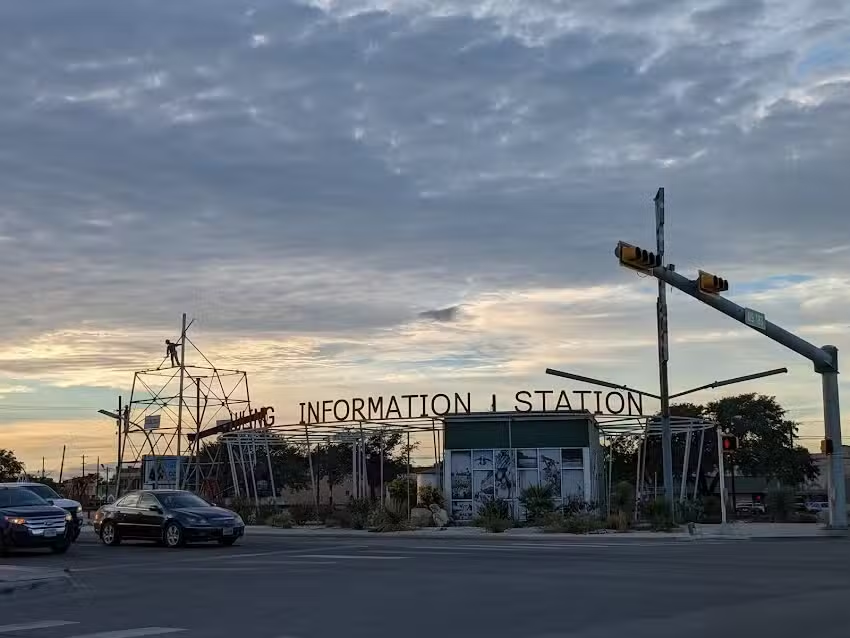
Luling Information Station
BackLocated at 637 E Pierce St in Luling, Texas, the Luling Information Station presents itself as a physical resource for travelers. Classified as both a travel agency and a point of interest, its operational status confirms that it is an active establishment available to the public. The structure appears to be a modest, standalone building, suggesting a focus on providing direct, in-person services rather than operating as a large corporate travel firm. For individuals who prefer face-to-face interaction and personalized local advice, this establishment offers a tangible alternative to digital-only platforms. It functions in the traditional role of a tourist information center, a concept that remains valuable for visitors who have already arrived in a location and require immediate, practical information such as maps, brochures, or verbal directions to local attractions and amenities.
The primary advantage of a facility like the Luling Information Station lies in its potential for specialized, hyper-local knowledge. Unlike large online travel agencies that may have generic information, a local station is positioned to be a true destination specialist. Staff, presumably local residents, could offer nuanced insights into the area's attractions, from the famous Zedler Mill Paddling Trail to the city's renowned barbecue scene. They could provide details on seasonal events like the Watermelon Thump, offer tips on the best times to visit specific sites, or recommend lesser-known points of interest that might not appear in mainstream online searches. This type of on-the-ground intelligence is invaluable for creating authentic travel experiences and can greatly assist in last-minute trip planning for those already exploring the region between Austin and San Antonio.
Scope of Services: An Area of Uncertainty
Despite the potential benefits of its physical presence, the Luling Information Station is shrouded in a significant degree of ambiguity, primarily due to a near-total lack of a digital footprint. Extensive searches for an official website, social media profiles, or a portfolio of services yield no concrete results. This absence of online information creates a considerable challenge for prospective visitors and raises critical questions about its function as a modern travel agency. Potential customers have no way to ascertain key details in advance, such as:
- Operating Hours: Without a published schedule, visitors risk arriving to find the station closed, which can disrupt travel plans significantly.
- Specific Services Offered: It is unclear whether the station provides comprehensive booking services for accommodations, tours, or transport. Does it sell tickets to local attractions? Can its staff help arrange custom itineraries? Or is its function limited to dispensing free brochures and verbal advice?
- Professional Affiliations: There is no information regarding its connections to larger tour operators or travel networks, which could otherwise lend credibility and offer a wider range of options.
This information vacuum forces potential clients to visit the location without any prior understanding of what to expect. For the modern traveler accustomed to researching, comparing, and often pre-booking their activities online, this represents a substantial drawback. The inability to vet the establishment through online reviews or testimonials means that a visitor is placing their trust entirely in an unknown quantity. While it may excel as a source of local information, its capacity to function as a full-service agency that offers complex vacation packages or detailed travel coordination remains unverified.
The Double-Edged Sword of a Traditional Model
The operational model of the Luling Information Station is decidedly traditional, a characteristic that has both positive and negative implications for different types of travelers. On one hand, it caters to a segment of the population that is either less comfortable with technology or simply values the human element in customer service. For these individuals, speaking with a knowledgeable person is preferable to navigating websites and apps. This establishment provides a direct line to local expertise, which can be particularly helpful for older travelers or those seeking a more spontaneous, less structured travel style. It acts as a reassuring physical landmark in an unfamiliar place.
On the other hand, this reliance on a pre-digital model alienates a vast and growing demographic of travelers who depend on online tools for every stage of their journey. The lack of an online presence is no longer a minor inconvenience; it is a significant competitive disadvantage. Without a website, the station is invisible to anyone planning a trip from outside the immediate area. It cannot attract customers through search engine optimization, showcase its offerings through photo galleries, or build a reputation through client testimonials. This severely limits its reach and effectiveness as a proactive travel agency, relegating it to a more passive role as a resource for those who happen to stumble upon it. For a traveler looking to organize a detailed trip to the region, the Luling Information Station would likely not even appear as a potential resource during their research phase, as entities like the Luling Chamber of Commerce are more visible online.
Final Assessment for the Potential Customer
In conclusion, the Luling Information Station is best approached with a specific set of expectations. It should not be viewed as a comprehensive travel agency capable of handling intricate bookings or planning extensive vacation packages from afar. The complete absence of an online presence and verifiable customer reviews makes it an unsuitable primary resource for anyone conducting pre-trip research. The risk of arriving to find it closed or unable to provide the specific service needed is a real consideration.
However, for the visitor already in Luling who is seeking immediate, localized information, the station could prove to be a useful stop. Its value lies in its potential role as a tourist information center—a place to grab a map, ask for a dinner recommendation, or get directions. It is a tool for on-the-ground enhancement of a trip, not its foundational planning. Travelers should consider it a supplemental resource, leveraging it for the kind of insider tips that only a local can provide, while relying on more digitally accessible and verifiable businesses for their core trip planning and booking needs. The establishment exists as a throwback to a different era of travel, offering a simple, direct form of assistance that, while limited in scope, still holds a niche value.